



Ultimate Guide to Sourcing OE-Quality Auto Parts
 Article authored by the Elecdura Supply Chain Expert Team, with over a decade of experience empowering global importers, wholesalers, and distributors. |
If you buy, import, or custom-develop automotive electrical parts, you don’t just need a good unit price—you need consistent OE‑quality, verifiable traceability, predictable lead times, and a total landed cost you can defend to finance. This guide is written for two core audiences: importers/distributors managing multi‑brand aftermarket catalogs and OEM/custom procurement teams that collaborate with engineering on prototypes and PPAP. You’ll leave with practical checklists, simple templates, and worked examples you can use in your next sourcing cycle.
No hype, no vague advice—just standards‑aligned playbooks grounded in IATF 16949, PPAP, and AQL, plus logistics math that actually moves your P&L. If your mandate is sourcing OE‑quality auto parts at scale, here’s a practical path you can implement.
Choosing Genuine, OE, OEM, or Aftermarket: A quick buyer’s lens
You don’t need a textbook—just a clear framing of risk, cost, and application. Think of these tiers as knobs you turn based on safety criticality, warranty exposure, and price elasticity.
Tier | What it typically means | Where it fits | Notes |
|---|---|---|---|
Genuine | Vehicle maker branded, factory spec | Warranty-critical replacements, high risk | Highest cost; perfect spec match |
OE | Same as factory-installed without automaker branding | Routine replacements where exact spec matters | Often same maker as Genuine |
OEM | Meets factory specs from an approved supplier | Balanced cost/quality for mainstream SKUs | Confirmation testing still essential |
Aftermarket | Third-party; quality varies widely | Budget-sensitive, non-critical, or performance variants | Vet thoroughly; rely on standards & inspection |
If you’re sourcing OE‑quality aftermarket, you’ll run OEM/Aftermarket channels but hold them to OE‑level validation and traceability. The rest of this guide assumes you’re focused on sourcing OE‑quality auto parts with verifiable documentation.
Standards for sourcing OE-quality auto parts you can trust
When a vendor claims “OE‑quality,” anchor that statement to auditable systems and documents.
Start with certification and scope. Confirm whether the manufacturing site is certified to IATF 16949 under the correct scope, and verify the certificate on the authority’s portal; the official navigation hub is the IATF Global Oversight homepage. See the authoritative index at the IATF site in the resource, “IATF Global Oversight — homepage,” for Rules, sanctioned interpretations, and customer‑specific requirements.
Align with customer‑specific requirements where relevant. For example, the January 2025 GM Customer‑Specific Requirements tighten expectations for production and service parts, including PPAP alignment and supplier development. Review the public GM CSR document on the IATF portal via the resource “IATF 16949 — GM Customer‑Specific Requirements — January 2025.”
Specify PPAP deliverables. The industry baseline is the AIAG PPAP manual; Level 3 is the common default for new or significantly changed parts. The AIAG catalog page, “AIAG — Manuals catalog (PPAP),” outlines the core tools and manuals you’ll align on.
A pragmatic supplier audit flow (expressed as prose to keep things scannable): begin with management commitment and QMS evidence, then process controls and Core Tools deployment (APQP, DFMEA/PFMEA, MSA, SPC), followed by traceability (lot coding, material certificates), calibration and lab methods for E/E validation, packaging/labeling controls, and change management. Close with incoming/outgoing inspection plans and a documented corrective‑action system.
For incoming inspection, set clear AQL‑based acceptance plans. ISO 2859‑1 defines how you size samples and make accept/reject decisions. You can read the official scope and abstract at the ISO Online Browsing Platform entry for ISO 2859‑1.
Supplier selection and onboarding that prevent surprises
Put structure around vendor selection so you aren’t guessing six months from now.
Scorecard criteria. Weight IATF certification status and performance history (PPM, OTD variance), PPAP capability and responsiveness, engineering collaboration depth (rapid prototyping, test method clarity), and logistics fitness (packing density, CBM documentation, export compliance). Financial health and capacity headroom matter more than you think when disruptions hit.
RFQ and samples. In your RFQ, state the expected PPAP level, special characteristics, test standards (e.g., insulation resistance method referencing IEC 60512; thermal cycling profiles based on ISO 16750 families), and labeling/traceability requirements. Ask for preliminary control plans and inspection records with pilot samples.
Onboarding gates. Use a phased acceptance: pilot lot under Level II AQL, short‑interval reviews on PPM and line‑fit issues, then ramp. Tie price breaks to demonstrated quality and delivery stability, not just volume.
For readers new to cross‑border sourcing mechanics, this primer helps: see the internal resource “5 Key Steps and Pitfalls to Avoid When Sourcing Auto Parts from China for the First Time,” which walks through vetting, prototypes, inspections, and Incoterms.
Cost and logistics optimization: Model total landed cost like finance does
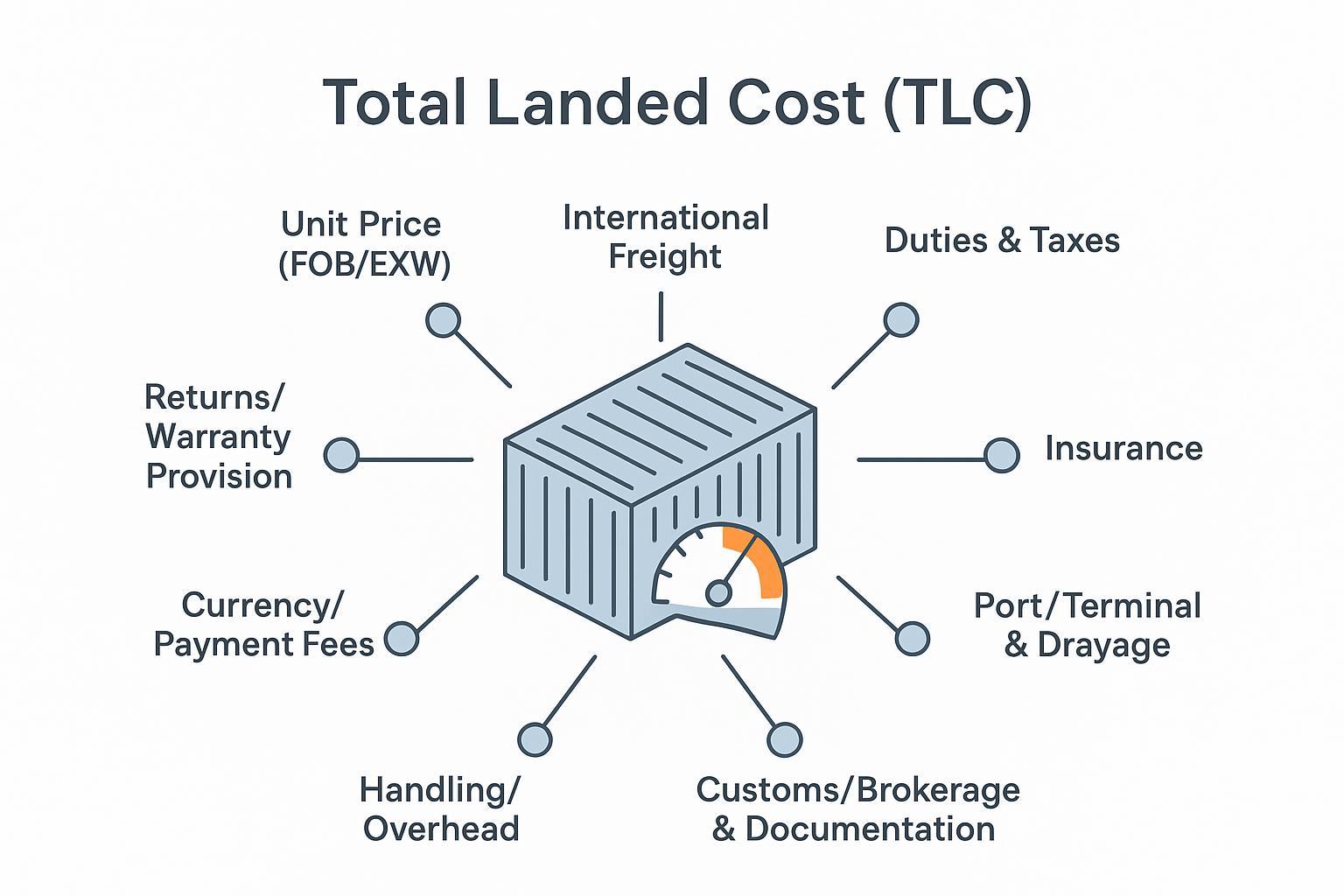
Unit price is only one input. Total landed cost (TLC) typically equals product cost plus international freight, duties/taxes, insurance, brokerage/documentation, port/terminal and drayage, handling/overhead, currency/payment fees, and a prudent returns/warranty provision. A concise overview you can share with colleagues is NetSuite’s guide on landed cost.
Two moves matter most for distributors importing multi‑SKU electrical catalogs:
Raise container utilization. Model CBM per SKU, then build mixed loads that maximize fill rate without over‑indexing on slow movers. Even a 10–15% jump in utilization can shave meaningful dollars off per‑unit TLC.
Negotiate MOQ based on CBM, not just units. If the pack density of a harness versus an alternator differs 3×, normalize MOQ in CBM terms to avoid air pockets.
Worked sensitivity example. Imagine a 40HQ with 2,000 alternators at 0.008 CBM each (16 CBM), plus mixed wiring harnesses bringing total to 58 CBM. If ocean freight is $6,800 and fixed fees total $1,200, the freight/fees portion is $8,000. At 58/68 CBM utilization, you’re paying $8,000/2,600 units ≈ $3.08 per unit; at 66/68 CBM (through better mix/MOQ), it drops toward ~$2.71 per unit. Across a catalog, those cents compound.
Disruption context you can cite in planning. UNCTAD’s Review of Maritime Transport 2024–2025 reports that Red Sea/Suez disruptions in 2024 pushed route distances up and rate volatility higher, with easing projected as new capacity absorbs demand from mid‑2025 onward. See the UNCTAD 2024 overview PDF and the 2025 publication page for macro trends you can use in your buffer and routing assumptions. DHL’s 2024 investor presentations also show ocean volume recovery with rate volatility, useful when sanity‑checking your forwarder quotes and lead‑time variance.
Practical consolidation workflow (example). Disclosure: Elecdura is our example supplier. A distributor consolidates alternators and starters across brands into a single monthly load. The vendor models MOQ in CBM, aligns AQL sampling plans for incoming checks, and sequences production across multiple factories to hit a single cut‑off. In one cycle, they test an alternator mix using the vendor’s category data (see the alternators category overview) to push utilization from 58 to 66 CBM without bloating slow‑moving SKUs. Outcome: lower per‑unit TLC and a tighter two‑week delivery window—achieved through math and scheduling, not magic.
Incoming inspection and AQL: A simple plan that actually works
Acceptance sampling protects you without grinding operations to a halt. Here’s how to set it up in plain language.
Pick the lot and inspection level. Define your lot size (e.g., 2,600 units across variants) and use General Inspection Level II as your default for routine receipts.
Choose AQL bands by risk. Typical bands: critical defects 0% (no critical failures allowed), major defects around 1.0–1.5%, minor defects around 2.5–4.0%. Document examples per SKU (e.g., reversed polarity lead is major; scuffed housing may be minor if cosmetic only).
Read the plan and decide. Use the ISO 2859‑1 tables to get sample size and Ac/Re (accept/reject) numbers. If you hit reject, quarantine and decide on 100% sort, rework, or return. Even when you “accept,” escalate immediately if criticals appear.
You can confirm the method and scope on the ISO OBP page for ISO 2859‑1. For electrical components, align your inspection methods with the same test procedures cited in PPAP (e.g., basic functional test, insulation resistance, torque on terminals, labeling/traceability checks).
Traceability and anti‑counterfeit controls
Traceability isn’t just for recalls—it’s how you reduce claims and avoid counterfeit exposure.
Serialization and lot tracking. Require lot‑level codes at minimum; for higher‑risk parts, move to unique serials and keep a digital chain from raw material to shipment.
Direct part marking and secure packaging. Laser or dot‑peen direct marks plus tamper‑evident packaging raise the bar for counterfeiters and simplify returns processing.
Supplier documentation trail. Keep material certs, test reports, and PSWs tied to each lot; ensure labels and cartons match PSW identifiers.
For a high‑level primer on automotive anti‑counterfeiting efforts, the Automotive Anti‑Counterfeiting Council maintains a public FAQ. Tie these practices back to IATF’s traceability expectations for safety‑critical items, and make sure your process aligns with your defect‑containment workflow.
Resilience by design: Multi‑factory sourcing, alternates, and safety stock
Lead‑time stability is now a design variable. Build resilience deliberately.
Multi‑factory coordination. Dual‑source critical SKUs across factories with compatible processes and tool duplication plans; harmonize control plans and labeling so lots remain interchangeable.
Alternate materials/components. For connectors and harnesses, approve alternate plating or resin grades with pre‑agreed validation so you can pivot without restarting PPAP from scratch.
Safety stock and buffers. Use realistic lead‑time variance (include rerouting via the Cape of Good Hope when relevant) to set buffers. UNCTAD’s 2024–2025 analyses and DHL’s market views give you defensible assumptions for executive review.
Measure resilience with hard KPIs: OTD variance, plan adherence to PPAP milestones, incoming PPM trends by factory, and the percentage of SKUs with qualified alternates. Keep reinforcing the fundamentals: sourcing OE‑quality auto parts successfully means blending standards discipline with logistics pragmatism.
Compliance and documentation essentials (U.S. oriented)
Don’t treat compliance as an afterthought. It affects cost, lead time, and risk.
Country of origin marking. U.S. rules are defined in 19 CFR Part 134. Items must be legibly and permanently marked in English with the country of origin, with exceptions in Subpart D. Review the eCFR Part 134 page when setting up labeling and packaging.
HS classification and duty. Classify precisely to avoid surprises. Automotive parts often default to HTS Chapter 87, but specific function and composition control duty rates. For complex calls, consider a CBP binding ruling; see the CBP program overview for how to request rulings.
NHTSA recall and EWR basics. If you’re a manufacturer of motor vehicle equipment, understand the Early Warning Reporting obligations (49 CFR Part 579) and defect reporting (Part 573). The NHTSA Early Warning Reporting overview summarizes what and when to report.
Always coordinate with customs brokers and legal/compliance teams; this guide is informational, not legal advice.
Case mini‑examples and tools you can reuse
Distributor TLC win. A buyer combines multi‑brand alternators and harnesses, normalizes MOQ in CBM, and uses a simple container‑fill model. Result: freight/fees per unit down ~12% and fewer LCL spillovers—a repeatable approach to sourcing OE‑quality auto parts efficiently.
OEM/custom PPAP path. Engineering and procurement align on Level 3 PPAP, define special characteristics (e.g., torque specs and insulation resistance), and require lab method citations in the control plan. First‑time yield improves because expectations were explicit.
Claims reduction via AQL. A distributor introduces a Level II plan with AQL 1.5/4.0 for major/minor, clarifies defect definitions with suppliers, and halves incoming PPM within two quarters.
Tools to replicate this at your desk today: a supplier audit checklist mapped to IATF clauses, a PPAP level trigger matrix, a Level II AQL template with critical/major/minor bands, a landed‑cost calculator that takes price, CBM, freight, duty, insurance, handling, and returns provision, and a resilience scorecard. If you’re starting from scratch, use the beginner’s internal resource on first‑time sourcing pitfalls to orient your process before you add depth.
Closing and next steps
Sourcing OE‑quality auto parts is a systems game. When you tie standards (IATF/PPAP/AQL) to vendor selection, model total landed cost accurately, and design resilience into your plan, quality gets boring—in the best possible way. Track KPIs like PPM, on‑time delivery variance, PPAP milestone adherence, and container utilization; review them monthly with suppliers.
If you’d like a neutral point of view on consolidation modeling or PPAP/readiness reviews, speak with a qualified one‑stop supplier experienced in engineering collaboration and multi‑factory coordination—Elecdura can be one of your options.
References (selected)
IATF Global Oversight — homepage for Rules/CSRs/SIs: https://www.iatfglobaloversight.org
IATF 16949 — GM Customer‑Specific Requirements — January 2025 (PDF): https://www.iatfglobaloversight.org/wp/wp-content/uploads/2025/01/IATF-16949-GM-Customer-Specific-Requirements-January-2025.pdf
AIAG — Manuals catalog (PPAP): https://www.aiag.org/training-and-resources/manuals
ISO 2859‑1 (AQL) — ISO Online Browsing Platform abstract/scope: https://www.iso.org/obp/ui/
UNCTAD — Review of Maritime Transport 2024 overview PDF: https://unctad.org/system/files/official-document/rmt2024overview_en.pdf
UNCTAD — Review of Maritime Transport 2025 page: https://unctad.org/publication/review-maritime-transport-2025
DHL Group — 2024 investor presentations (ocean volume/rate context): https://group.dhl.com/content/dam/deutschepostdhl/en/media-center/investors/documents/presentations/2024/DHL-Group-Q3-2024-Roadshow-Presentation.pdf
NetSuite — landed cost overview: https://www.netsuite.com/portal/resource/articles/inventory-management/landed-cost.shtml
eCFR — 19 CFR Part 134 Country of Origin Marking: https://www.ecfr.gov/current/title-19/chapter-I/part-134
NHTSA — Early Warning Reporting overview: https://www.nhtsa.gov/vehicle-manufacturers/early-warning-reporting
Internal resources (optional reading)
Further reading for beginners: 5 Key Steps and Pitfalls to Avoid When Sourcing Auto Parts from China for the First Time — https://www.elecduragroup.com/5-Key-Steps-and-Pitfalls-to-Avoid-When-Sourcing-Auto-Parts-from-China-for-the-First-Time.html
Alternators category overview (for consolidation modeling context): https://www.elecduragroup.com/Alternators.html
Elecdura homepage: https://www.elecduragroup.com/
Get Exclusive Industry Insights Delivered. Please Contact Us!
Recommended Products

OEM 50905072 24V Starter Motor – Aftermarket Replacement for SCANIA & Heavy-Duty Applications

Alternator 12V 190A Compatible for Bentley Continental GT 6.0L OEM 07C903021J

Starter Motor for Smart Fortwo Passion 2008-2016 A1321510001

Alternator Replacement for Dodge for Ram 1500 5.7L 2009-2010, 1756 56028697AL