Germany Alternator Supplier Guide for European Distributors
Germany is Europe's largest automotive aftermarket, home to more than 49 million registered passenger cars and an average vehicle age that has climbed past 10.6 years — and now stands at 10.9 years as of 2026. For European distributors, this aging fleet means sustained demand for replacement alternators across a vast range of vehicle makes and models. But sourcing the right alternator supplier for the German market requires more than finding the lowest price. It demands a partner who understands EU compliance, delivers consistent OE quality, and can scale with your business.
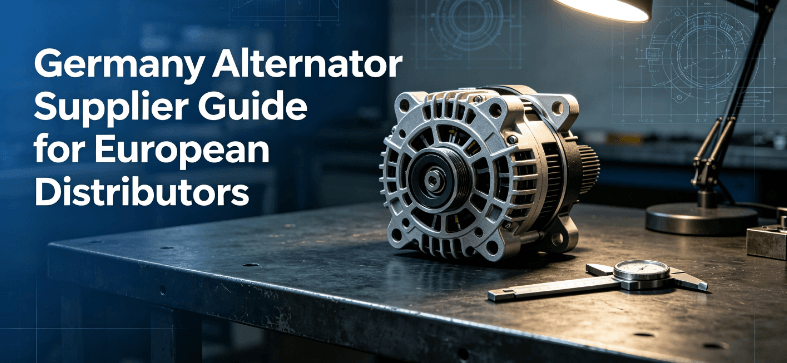
This guide breaks down what European distributors should look for when sourcing wholesale alternators from Germany — and how an integrated supply partner like Elecdura can simplify the entire process.
Key Takeaways
Germany's automotive aftermarket is among the largest in Europe, driven by an aging vehicle fleet and consistent demand for replacement parts.
The average age of passenger cars in Germany reached 10.9 years in 2026, driving sustained demand for replacement alternators.
IATF 16949 certification is the non-negotiable quality standard for any OE Quality Alternator wholesale supplier serving the German market.
EU import regulations require CE marking and E-Mark certification for automotive electrical components entering Germany.
A reliable alternator supplier combines certified quality, broad vehicle coverage, flexible MOQ, and responsive technical support.
Why Germany Demands a Different Approach to Alternator Sourcing
The German market has three characteristics that separate it from other European markets.
First, the fleet is aging. With more than 49 million passenger cars and an average vehicle age of over 10 years, German distributors need alternators that fit a wide range of older models — not just current production vehicles.
Second, quality expectations are high. German automotive standards are among the most stringent in the world. The IATF 16949 certification, which was developed with significant German automotive industry input, sets the benchmark for supplier quality systems. A 2026 study of German workshops found that 71% of independent repair shops source parts through independent wholesalers, while 77% of OEM workshops rely on the OE network. This means distributors must be prepared to supply both channels with products that meet or exceed original equipment standards.
Third, regulatory compliance is complex. Importing automotive parts into Germany requires navigating EU customs procedures, CE marking requirements, and REACH compliance. Customs duties apply to automotive parts imported into Germany, and CE marking is mandatory for many electrical components.
What European Distributors Should Look for in an Alternator Supplier
1. Certifications and Compliance Documentation
The foundation of any reliable alternator supplier is certification. For the German market, look for IATF 16949 — the automotive industry's global quality management standard. This certification confirms that the supplier follows structured quality control, defect prevention, and continuous improvement processes.
Beyond IATF 16949, European distributors should verify:
CE marking for electrical safety compliance
E-Mark certification for automotive components
REACH compliance for material safety
RoHS declarations for hazardous substance restrictions
A supplier who proactively provides these documents — rather than requiring you to chase them — saves months of customs delays and compliance headaches.
2. Product Quality and Testing Standards
Premium OE Quality Alternator wholesale products use 100% brand new components with 100% copper windings for superior conductivity and heat dissipation. Every unit should undergo rigorous testing before shipment, including load testing, thermal cycling, and vibration validation.
The difference between premium and budget alternators is measurable. Premium units typically deliver stable voltage output across the full RPM range, while lower-quality units may suffer from voltage drops at idle — a critical issue for modern vehicles with high electrical loads.
3. Vehicle Coverage and One-Stop Sourcing
Germany's vehicle fleet is remarkably diverse. A single distributor may need alternators for German brands (Volkswagen, Mercedes, BMW, Audi, Opel), French brands (Renault, Peugeot, Citroën), Italian brands (Fiat, Alfa Romeo), and Asian brands (Toyota, Hyundai, Nissan) — all within the same week.
A single factory rarely covers this range. The best alternator supplier for European distributors offers broad vehicle coverage through an integrated supply platform, consolidating multiple manufacturing resources to cover far more models and categories than any single factory could.
4. Supply Chain Flexibility and MOQ
For distributors testing new product lines or entering new regions, high minimum order quantities are a barrier. Look for suppliers who offer:
| Sourcing Factor | What to Look For |
|---|---|
| MOQ | 100 units or lower, with mixed SKUs accepted |
| Lead Time | 7–60 days depending on order size |
| Payment Terms | Flexible options for established partners |
| Consolidation | Ability to combine multiple SKUs into one shipment |
| Sample Orders | Available for fitment and quality verification |
5. Technical Support and Responsiveness
When a fitment question arises or a quality issue needs investigation, response time matters. A supplier who replies within 4 hours demonstrates stronger operational capability than one who takes days.
Why an Integrated Supply Platform Outperforms Traditional Sourcing
Traditional sourcing means managing multiple factories, each with different quality standards, lead times, and communication styles. This fragmentation creates inefficiencies, quality inconsistencies, and hidden costs.
An integrated supply platform like Elecdura offers a fundamentally different model. Rather than being a single factory, Elecdura consolidates and screens multiple long-term manufacturing partners — giving European distributors access to:
Supplier screening capability — saving months of factory vetting, trial, and error
Tiered supply options — different tiers based on your market positioning, quality requirements, and volume plans
Broad vehicle and category coverage — covering far more models than any single factory could
Flexible payment terms — customized deposit ratios and extended cycles for stable partners
Marketing and promotion support — images, copy, and design assistance for regional campaigns
Long-term cooperation pathways — regional distributorships, category exclusives, and priority access to new products
For European distributors navigating the German market's complexity, this integrated approach delivers something traditional sourcing cannot: a single partner who understands the full scope of your needs.
Frequently Asked Questions (FAQ)
A: IATF 16949 is the primary quality certification. CE marking and E-Mark certification are also required for automotive electrical components entering the EU market.
A: Customs duties apply based on the HS code. Consult a customs broker for current rates.
A: Lead times typically range from 7 to 60 days depending on order size, model availability, and customization requirements.
A: Yes. Many integrated suppliers allow mixed SKUs to meet MOQ, enabling distributors to test multiple product lines in a single order.
A: Industry benchmarks range from 12 to 36 months. Longer warranties indicate the supplier has completed thorough durability testing.
A: Request test reports (load, thermal, vibration), confirm IATF 16949 certification, and inspect sample units before placing bulk orders.
A: Yes. Professional suppliers provide OEM/ODM services including private labeling, custom packaging, and output tuning for qualified volumes.
External Resources (High-Authority Links)
Need a reliable alternator supplier? Contact Elecdura today for a catalog, sample order, or wholesale quote.
This guide is for informational purposes. Always verify specifications with your supplier before ordering.